


Feline diabetes is a growing concern
Diabetes currently affects approximately 1 in 250 cats.3
With 1 out of 3 cats believed to be overweight, and obesity being a risk factor for feline diabetes, that number may be expected to grow.4,5
Common challenges and concerns in feline diabetes
Managing feline diabetes presents several clinical, practical and emotional challenges.6,7,8 Understanding these from the outset can help veterinary teams effectively support owners, from their cat’s initial diagnosis through to successful long-term management.
Clinical considerations for insulin treatment
Achieving rapid and stable glycaemic control can be demanding. Insulin therapy requires dose optimisation, carries a risk of symptomatic hypoglycaemia and usually requires blood glucose curves or the use of a Continuous Glucose Monitoring (CGM) device. Cat owners can also be reluctant to agree to treatment – sadly, data prior to Senvelgo® coming to market, showed that around 10% of owners chose to have their cat euthanised at diagnosis6.
Practical adherence and owner confidence
Twice-daily injections, strict routines and monitoring requirements may feel overwhelming for some owners. Fear of giving injections, concern about hypoglycaemia and cost considerations can all affect long-term confidence and compliance.
Quality of life concerns
Owners often worry about their cat’s comfort and stress around injections, as well as the broader impact of treatment on daily life. Lifestyle demands, availability of family members to administer injections and anticipated pet reactions can all influence decision-making.
Risk factors
All cats are potentially susceptible to diabetes, with the vast majority suffering from insulin resistance diabetes, which is similar to type 2 diabetes in people.
Risk factors include:
-

Obesity
-
Increased age
-
Lack of physical activity
-
Corticosteroid therapy
-
Neutering
-
Genetics and breed predisposition
-
Concomitant disease (e.g. other hormonal diseases)
Senvelgo®: easing the burden of diabetes
Prior to Senvelgo®, the complexity and time required to treat diabetes can lead to compliance issues, treatment abandonment, and even the tragic loss of patients’ lives.6 As a convenient, once-daily oral solution, Senvelgo® can help change that.
Diagnosing a cat with diabetes can be a stressful moment for vets and cat owners alike. While insulin, thankfully, made feline diabetes a treatable condition, it still involves:
-
Twice-daily injections and significant lifestyle changes for the owner
-
Training the owners to correctly handle and inject insulin
-
Finding the right dose and time-consuming blood glucose curves or monitoring with CGM devices
-
The ongoing risk of hypoglycaemic events
Senvelgo® eliminates these concerns, helping make it possible for your client and patient to enjoy a normal quality of life, despite this disease.
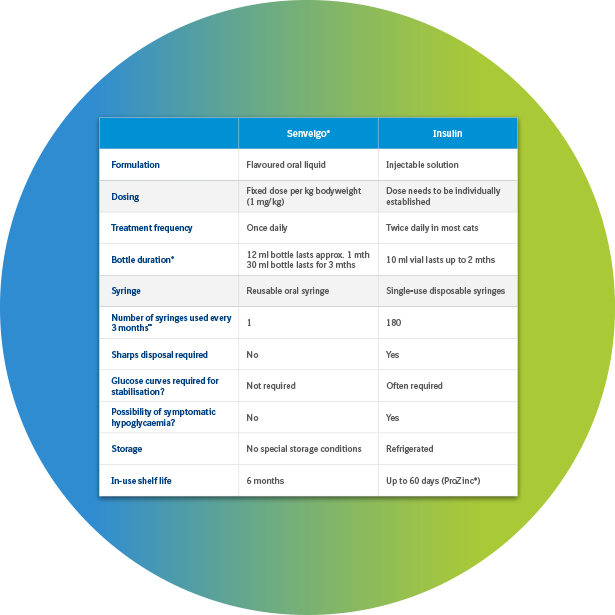
Using Senvelgo® is different to insulin
Treating diabetes in cats with Senvelgo® is different to treating with insulin, with both medical and practical benefits. Cats usually show improvement in glycaemic control shortly after starting Senvelgo®, with reduction of elevated blood glucose usually seen within a week.1,2
Click below to download our handy guide which compares the practical differences between using Senvelgo® and insulin treatment.
-
1. Niessen, S. J. M. et al. (2022) Once daily oral therapy for feline diabetes mellitus: evaluation of SGLT-2 inhibitor velagliflozin as stand-alone therapy compared to insulin injection therapy in diabetic cats. Journal of Veterinary Internal Medicine 36, 2512–2513.
-
2. Sparkes, A. H. et al. (2015) ISFM Consensus Guidelines on the Practical Management of Diabetes Mellitus in Cats. J Feline Med Surg 17, 235–50.
-
3. Waite, O. et al. (2025) Frequency, Risk Factors, and Mortality for Diabetes Mellitus in 1 225 130 Cats Under Primary Veterinary Care in the United Kingdom in 2019. JVIM 39:e70161.
-
4. Rand J, Gottlieb, SA. Feline diabetes mellitus. Textbook of Veterinary Internal Medicine, 8th edition. Ettinger SJ, Feldman EC and Cote E, eds. Elsevier, Missouri. 2017;1781-1795.
-
5. 2018 Summary of the Veterinary Clinic: Pet Obesity Prevalence Survey & Pet Owner: Weight Management, Nutrition, and Pet Food Survey. Available at:
https://petobesityprevention.org/2018. -
6. Niessen, S. J. M. et al. (2017) The Big Pet Diabetes Survey: Perceived Frequency and Triggers for Euthanasia. Vet Sci 4, 27.
-
7. Diabetes in Cats: Quantitative market research study. Proprietary presentation, July 19, 2021. Kynetec; St. Louis, MO, on behalf of Boehringer Ingelheim.
-
8. Niessen, S. J. M. et al. (2010) Evaluation of a quaility-of-life tool for cats with diabetes mellitus. J Vet Intern Med 24, 1098-105.
-
9. Best New Product of the Year, 2024/2025 UK Veterinary Marketing Association (VMA) Awards
-
10. Behrend, E. N. et al. (2024) Velagliflozin, a once-daily, liquid, oral SGLT2 inhibitor, is effective as a stand-alone therapy for feline diabetes mellitus: the SENSATION study. JAVMA 262, 1343-1353.
-
11. Niessen, S. J. M. et al. (2024) Efficacy and safety of once daily oral administration of sodium-glucose cotransporter-2 inhibitor velagliflozin compared with twice daily insulin injection in diabetic cats. J Vet Intern Med 38, 2099–2119.
-
12. VMD. Summary of Product Characteristics (SPC): Senvelgo® 15mg/ml oral solution for cats (velagliflozin). Veterinary Medicines Directorate, UK.
-
13. Reusch C, Chapter: 291 Feline Diabetes Mellitus, In: Ettinger J, Feldman E; editors. St Louis, Missouri, Saunders Elsevier; Textbook of veterinary internal medicine. 10th ed. 2010 p 1796-1816.